




By Suleiman Aremu | Solaremnews
The National Chairman of the All Progressives Congress (APC), Professor Nentawe Yilwatda, and the Sultan of Sokoto, His Eminence Muhammad Sa’ad Abubakar, have called on Nigerians of all faiths and backgrounds to embrace religious tolerance, unity and peaceful coexistence as essential steps towards building a greater and more prosperous Nigeria.
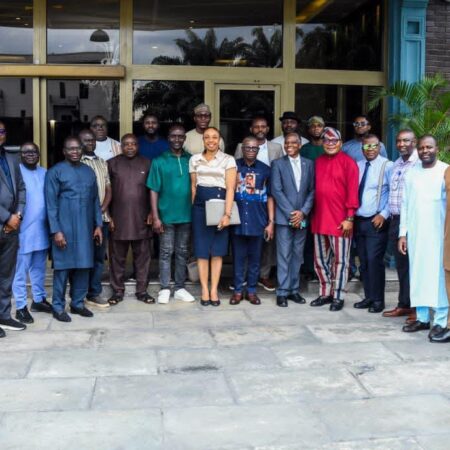
The two prominent leaders made the call in their separate speeches at the opening ceremony of an international conference on “Diversity and Social Peace: A Partnership for a Promising Future,” organised by the Muslim World League in Abuja.
Yilwatda described Nigeria’s diversity of religions, ethnicities, languages, cultures and traditions as a defining feature of the country, stressing that the diversity should be transformed from a potential source of division into an instrument of national strength and development.
The APC National Chairman challenged Nigerians to look beyond religious and ethnic identities and recognise their shared humanity and common destiny, saying the fundamental question should not be whether Christians and Muslims could live together, but what kind of nation they were building through the way they coexisted.
In a statement by his Special Adviser on Media and Information Strategy, Abimbola Tooki, Yilwatda drew from his personal experiences growing up in Yobe State and witnessing communal conflicts in Plateau State to illustrate the importance of inter-religious understanding.
He recalled the close friendship between his late father, a pastor, and the Chief Imam of Nguru, saying their relationship demonstrated that religious differences should never become barriers to friendship, mutual respect and peaceful coexistence.
“Religious difference does not have to produce human distance. Indeed, our differences should not prevent us from recognising what we share. We may worship differently, but we share the same humanity. We may speak different languages, but we share the same hopes for our children. We may come from different communities, but we share one country and one future,” he said.
Yilwatda, however, warned that Nigeria’s diversity could become dangerous when citizens were encouraged to dehumanise people of other faiths or ethnic backgrounds.
He identified terrorism, banditry, farmer-herder conflicts, communal violence, ethnic suspicion, religious intolerance, hate speech and the political manipulation of identity as major threats to national cohesion.
According to him, terrorism might attempt to assume a religious identity, while banditry could exploit ethnic narratives and political actors could seek to weaponise identity for electoral advantage.
He maintained that none of these tendencies should be allowed to define Nigeria or its people.
“The real battle is for the soul of our nation. And that battle cannot be won by security measures alone,” Yilwatda said, stressing that lasting peace required justice, education, responsible leadership, economic opportunity, dialogue and moral courage.
He called on religious leaders to use their enormous moral influence to promote tolerance, reconciliation and peaceful coexistence, urging churches and mosques to become centres of peace and platforms for teaching citizens how to live together despite their differences.
The APC National Chairman also urged political leaders to resist exploiting religious and ethnic sentiments for political gain.
He called on traditional rulers to use their influence to make reconciliation stronger than retaliation, dialogue stronger than suspicion and justice stronger than vengeance.
Yilwatda further challenged academics and civil society organisations to educate a new generation of Nigerians to see the country’s diversity as an asset rather than a threat.
He proposed what he described as a “Nigerian Covenant for Coexistence”, a shared moral commitment by religious leaders, political leaders, traditional institutions, civil society organisations and citizens to reject violence, hate speech, religious intolerance and the politicisation of identity.
Under the proposed covenant, he said Nigerians should commit themselves to protecting places of worship, defending vulnerable communities and teaching children that people who worship differently are not their enemies.
He stressed that whenever any community was attacked, Nigerians should not first ask whether the victims belonged to their ethnic or religious group, but whether they were human beings deserving of protection.
“The future of Nigeria cannot be secured by one faith defeating another, or one ethnic group prevailing over another. There is no victory in destroying the house we all call home,” he declared.
Yilwatda urged Nigerians to choose dialogue over confrontation, reconciliation over revenge, justice over vengeance and humanity over identity.
He said Nigeria did not need less diversity but greater wisdom and leadership to manage its diversity, adding that the country must build a society where Christians and Muslims could defend one another, not because they shared the same faith, ethnicity or political affiliation, but because they shared the same humanity.
Responding to the APC National Chairman’s remarks, the Sultan of Sokoto, Muhammad Sa’ad Abubakar, commended Yilwatda for what he described as a profound and comprehensive intervention on how Nigeria could resolve its differences and build a peaceful society.
The Sultan recalled that the Nigerian Inter-Religious Council (NIREC) was established by Christian and Muslim leaders as a platform for dialogue and interaction towards peaceful coexistence, rather than as a creation of government.
He urged Nigerians to stop insulting and demonising one another, stressing that all human beings were created equal by God and that no individual or group was inherently superior to another.
According to him, one of the major challenges confronting Nigeria was the absence of honesty and trust among citizens.
“We lack honesty and trust. We don’t trust ourselves, and that is where the problem is. Nobody is better than another person,” the Sultan said.
He expressed appreciation for Yilwatda’s emphasis on humanity, noting that the message provided an important pathway towards resolving Nigeria’s religious and social differences.
The Sultan also commended the organisers of the conference for providing a platform for religious leaders, policymakers and other stakeholders to engage in meaningful discussions on diversity, peace and global security.
Representing President Bola Ahmed Tinubu at the event, the Deputy President of the Senate, Senator Barau I. Jibrin, said the Federal Government remained committed to collaborating with governments and relevant stakeholders to strengthen security and promote peace within Nigeria and across the world.
Barau reaffirmed the administration’s determination to preserve Nigeria’s unity despite its religious and ethnic diversity, stressing the need for the country to remain united and peaceful.
He urged participants to utilise the international platform to contribute to the global debate on peace and security, particularly at a time of increasing security challenges across the world.
The Deputy President of the Senate commended the Muslim World League for choosing Nigeria to host the international conference, expressing confidence that the deliberations would be robust and produce practical ideas capable of advancing global peace and security.
The conference brought together religious leaders, government officials, traditional rulers, members of the diplomatic community, academics, civil society actors and other stakeholders to deliberate on the management of diversity, inter-religious relations, social cohesion and the search for sustainable peace in Nigeria and beyond.







No Comment! Be the first one.