




Election observation group raises concerns over security risks, result transmission, voter inducement, urges INEC to ensure transparent, credible process
By Suleiman Aremu | Solaremnews
The European Union Support to Democratic Governance in Nigeria Election Observation Hub (EU-SDGN EOH) has deployed 843 accredited observers across Osun State to monitor Saturday’s governorship election, warning that vote buying, political violence, misinformation and unresolved disputes pose significant threats to the credibility of the poll.
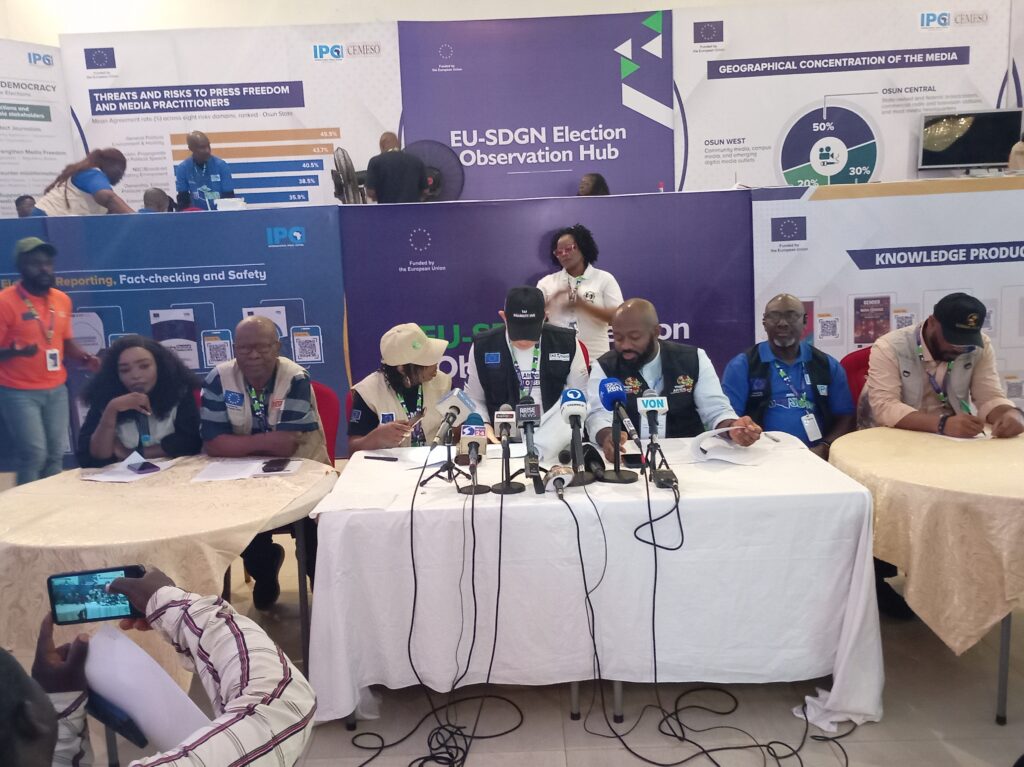
The Hub, comprising the Centre for Media and Society (CEMESO), International Press Centre (IPC), Nigerian Women Trust Fund (NWTF), TAF Africa, The Kukah Centre (TKC) and Yiaga Africa, made this known in its pre-election statement issued on Friday, August 14, 2026.
The statement, which follows its pre-election assessment report issued on July 12, said the observers would monitor, document and report the electoral process in accordance with the principles of independence, impartiality and non-partisanship, as well as the applicable codes of conduct for election observers.
According to the Hub, the Osun governorship election is particularly significant because it comes exactly five months to the 2027 general election and two months after the Ekiti governorship election, providing an opportunity to assess the implementation of the new electoral legal framework and the preparedness of the Independent National Electoral Commission (INEC), security agencies and other stakeholders ahead of 2027.
The election will be contested by 15 candidates across 3,763 polling units in 332 Registration Areas and 30 Local Government Areas of the state.
The number of registered voters stands at 2,339,233, representing an increase of 384,433, or 19.67 per cent, over the 1,954,800 registered voters recorded for the 2023 general election.
The figure is also 386,846, or 19.81 per cent, higher than the 1,952,387 registered voters for the 2022 Osun governorship election.
Of the 2,339,233 registered voters, the Hub said 1,906,390, representing 81.50 per cent, had collected their Permanent Voter Cards (PVCs), including 6,101 printed downloadable PVCs.
The group noted that the political landscape in Osun had undergone considerable realignment since the 2023 general election, with Governor Ademola Adeleke seeking re-election on the platform of the Peoples Democratic Party (PDP), while the All Progressives Congress (APC) candidate is Munirudeen Bola Oyebamiji, a former Commissioner for Finance in the state and former Director-General of the National Inland Waterways Authority (NIWA).
It added that Najeem Salaam, who served as Speaker of the Osun State House of Assembly from 2011 to 2019, is contesting under the platform of the African Democratic Congress (ADC).
The Hub also noted the addition of Social Democratic Party (SDP) candidate, Dr Francis Olugbenga Ajala, and his running mate, Faseke Babajimi Oladipo, to the list of candidates following a Federal High Court judgment.
On INEC’s preparedness, the EU-SDGN EOH said the Commission had declared itself operationally, technologically and logistically ready for the election.
It said the Resident Electoral Commissioner, Mrs Oluwatoyin Babalola, had confirmed the configuration and full charging of all Bimodal Voter Accreditation System (BVAS) devices, while non-sensitive materials had been batched and distributed.
According to the Hub, reprinted ballot papers containing the SDP’s details had also arrived, been inspected and delivered to the 30 Local Government Area offices.
It said an estimated 17,500 ad-hoc personnel had been recruited, trained and deployed, while 97 Super Registration Area Centres (Super-RACs) and 105 Registration Area Centres (RACs) had been activated to facilitate the deployment of personnel and materials and support the timely opening of the 3,763 polling units by 8:30 a.m.
The Hub, however, recalled that INEC conducted a mock accreditation exercise on August 1 in 12 Local Government Areas across the three senatorial districts to test the functionality of the BVAS.
It said the exercise, which attracted a large turnout of prospective voters, exposed technical challenges, including difficulties experienced by some BVAS devices in recognising voters’ biometrics.
Although INEC subsequently reported that the identified challenges had been resolved, the Hub noted that the Commission had increased the number of BVAS devices from 4,427 to 5,130, with 1,367 devices designated as backups.
The Commission, it added, had assured stakeholders that polling unit result sheets would be scanned and transmitted directly to the INEC Result Viewing Portal (IReV) after voting closes.
The EU-SDGN EOH urged INEC to sustain its vigilance and neutrality by ensuring timely and effective deployment of personnel and materials, as well as transparent, real-time collation, transmission and declaration of results.
On electronic transmission of results, the Hub raised concerns over the introduction of an electronic EC8A on the BVAS as part of a validation process without sufficient public explanation of where the results are transmitted or the precise purpose of the additional process.
It also expressed concern that results transmitted from polling units do not appear immediately on IReV because they reportedly pass through a backend validation process before publication.
The Hub said there was insufficient public information on what is checked during the process, who conducts the review or how long the process should take.
It warned that the existence of the physical EC8A, its scanned image on IReV, the copy retained on the BVAS and the electronically transmitted e-EC8A could create uncertainty if discrepancies arise without a clearly stated rule on which version would prevail.
The group further observed that IReV currently publishes polling unit results but does not publish ward-level and Local Government-level collation results, making it difficult for citizens, political parties and observers to independently verify whether aggregated results correspond with the individual polling unit results.
It therefore urged INEC to publish a comprehensive results-transmission protocol and ensure that the entire results chain, from polling unit to final declaration, is transparent and verifiable.
The Hub also noted that Section 65 of the Electoral Act 2026 allows INEC to review a result declaration within seven days, but expressed concern that the provision is triggered only by a report from INEC officials, which it said could limit the effectiveness of the safeguard in certain circumstances.
It said the EU-SDGN EOH, together with the Nigeria Civil Society Situation Room and 13 other organisations, had issued a joint statement on August 10 calling on INEC to subject the backend validation process to independent scrutiny and publish an end-to-end results transmission protocol.
On election security, the Hub described Osun as entering election day with a high overall security risk, identifying Osogbo and Irewole Local Government Areas as critical-risk areas.
It listed Boripe, Obokun, Ilesa West, Ife Central, Ife North, Iwo, Ede North, Ifedayo, Ilesa East, Isokan and Irepodun among the Local Government Areas assessed as high risk, while the remaining 17 Local Government Areas were classified as moderate or low risk.
According to the Hub, the security risks are largely driven by organised political violence allegedly linked to party-aligned thugs and youth groups, the unresolved dispute over control of Local Government secretariats, criminal elements exploiting the political environment for targeted attacks, as well as fake news, misinformation and disinformation.
It said previous incidents had included coordinated attacks on party leaders and offices, shootings at multiple locations, political abductions and violence during campaigns and rallies.
The Nigeria Police Force, as the lead agency for election security, has developed an operational framework involving a proposed deployment of up to 30,000 security and law enforcement personnel, including specialised, tactical and canine units.
The personnel are expected to be drawn from police formations across the country, with support from the Nigerian Army, Department of State Services, Nigeria Security and Civil Defence Corps, Nigeria Immigration Service, Nigerian Correctional Service, Federal Road Safety Corps and National Drug Law Enforcement Agency.
The deployment is being coordinated through the Inter-Agency Consultative Committee on Election Security (ICCES).
However, the EU-SDGN EOH expressed concern over allegations of misuse of force, police brutality, illegal arrests and extra-judicial killings, saying such allegations could undermine public confidence in the professionalism, neutrality and non-partisanship of security agencies.
It called on all security and law enforcement personnel deployed for the election to comply strictly with their codes of conduct and rules of engagement, while remaining professional, impartial and diligent in protecting voters, election officials, journalists, accredited observers and other stakeholders.
On inclusive participation, the Hub said women, youths and persons with disabilities remained significantly under-represented despite constituting a substantial proportion of the electorate.
It said women account for 49.50 per cent of the population and 52.79 per cent of registered voters in the state, while youths aged 18 to 34 constitute approximately 36 per cent of registered voters and represent the largest voting bloc.
The organisation urged INEC, security agencies, political parties, civil society organisations and other stakeholders to ensure the full, safe and unhindered participation of women, youths and persons with disabilities.
It recommended deliberate provision of transportation and assistive devices, gender-sensitive security planning and priority voting arrangements for vulnerable voters.
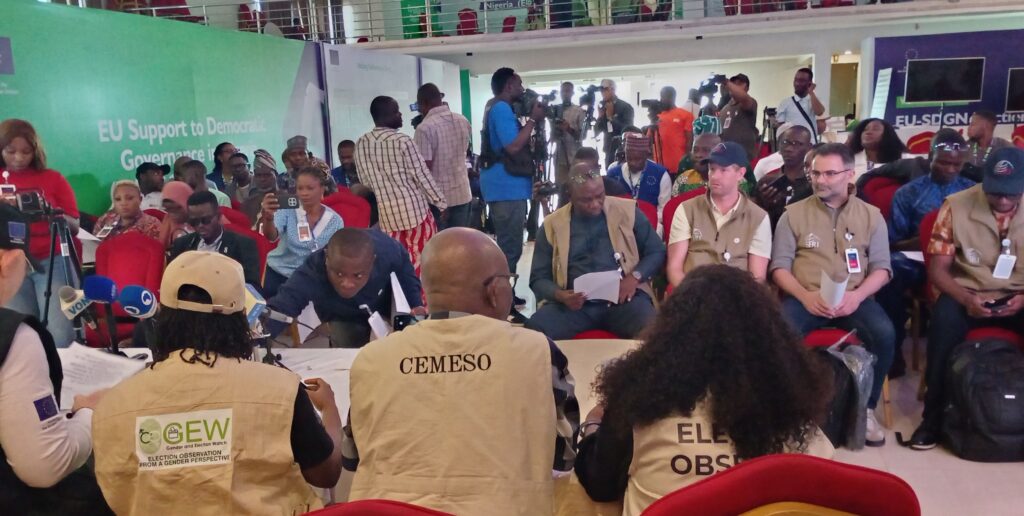
The Hub identified vote buying and voter inducement as the highest threat to the credibility of Saturday’s election, saying reports of financial and material inducements had circulated ahead of the poll.
It noted that INEC had indicated that plain-clothes financial intelligence officers, working with the Economic and Financial Crimes Commission (EFCC) and the Independent Corrupt Practices and Other Related Offences Commission (ICPC), would be deployed around polling units to deter and prosecute vote trading.
The Hub called for decisive and evidence-based action against individuals involved in vote buying, including arrest, investigation and prosecution, to serve as a deterrent to others.
It also warned that the information environment remained vulnerable to fake news, misinformation, disinformation and inflammatory political communication, particularly on Facebook, WhatsApp, TikTok and X, formerly Twitter.
It urged media organisations, civil society groups and regulatory bodies to intensify conflict-sensitive reporting and real-time fact-checking to prevent the escalation of political tensions before, during and after the election.
The EU-SDGN EOH called on political parties and candidates to respect the July 30, 2026 Peace Accord, accept the outcome as declared by INEC and pursue grievances through lawful and judicial channels rather than resorting to protests, violence or self-help.
It also urged political parties to refrain from vote buying, voter intimidation and deployment of political thugs at polling units and collation centres.
The Hub called on security agencies to maintain neutrality and professionalism, deploy adequate personnel and assets to critical and high-risk Local Government Areas, secure transport routes, polling units and collation centres in advance, and respond swiftly and proportionately to incidents of electoral violence.
It further urged security authorities to publicly disclose progress on investigations into electoral violence, including arrests, charges and court dates, in order to strengthen deterrence and demonstrate that impunity would not be tolerated.
For the media, the Hub advised journalists to verify information before publication, particularly information circulating on social media platforms, and refrain from publishing unofficial election results before they are formally declared by INEC at the appropriate collation level.
It also urged the media to adopt conflict-sensitive reporting capable of providing the public with accurate and comprehensive information while helping to reduce tension.
The Hub called on voters to turn out in large numbers, arrive at their designated polling units early and exercise their constitutional right to vote freely and independently.
It urged voters to reject financial and material inducements and report incidents of vote buying or other electoral malpractice to INEC officials, security agencies or accredited election observers.
The EU-SDGN EOH said the August 15 governorship election represented a critical milestone as the second major election conducted under the new electoral legal framework and an important indicator ahead of the 2027 general election.
It said the credibility of the election would ultimately depend on a free, fair, credible and peaceful process covering voting, collation and declaration, supported by a transparent and verifiable chain of results from polling units to the final declaration.
The Hub warned that fear of violence, unresolved litigation, operational and logistical challenges and lingering distrust must not discourage eligible voters from exercising their franchise or undermine confidence in the outcome.
It stressed that the people of Osun State deserved an election that would be free, fair, credible, inclusive and reflective of their sovereign will.
The EU-SDGN EOH said it would continue to observe the election process and issue a preliminary Election Day statement on Saturday, followed by a post-election report after the declaration of results.







No Comment! Be the first one.