




Civil society group commends voters, security agencies for resilience, restraint; calls for stronger safeguards against vote buying, violence ahead of 2027
By Suleiman Aremu | Solaremnews
Yiaga Africa has said the official results of the 2026 Osun State Governorship Election are consistent with its independent Process and Results Verification for Transparency (PRVT) estimates, indicating that the results announced by the Independent National Electoral Commission (INEC) reflect the ballots counted at polling units.
The organisation made this known on Sunday in its Process and Results Verification Statement on the August 15 governorship election, delivered at the Adolak Event Centre, Osogbo, by the Chair of its 2026 Osun Election Observation Mission, Dr Asmau Maikudi, and the Executive Director of Yiaga Africa, Samson Itodo.
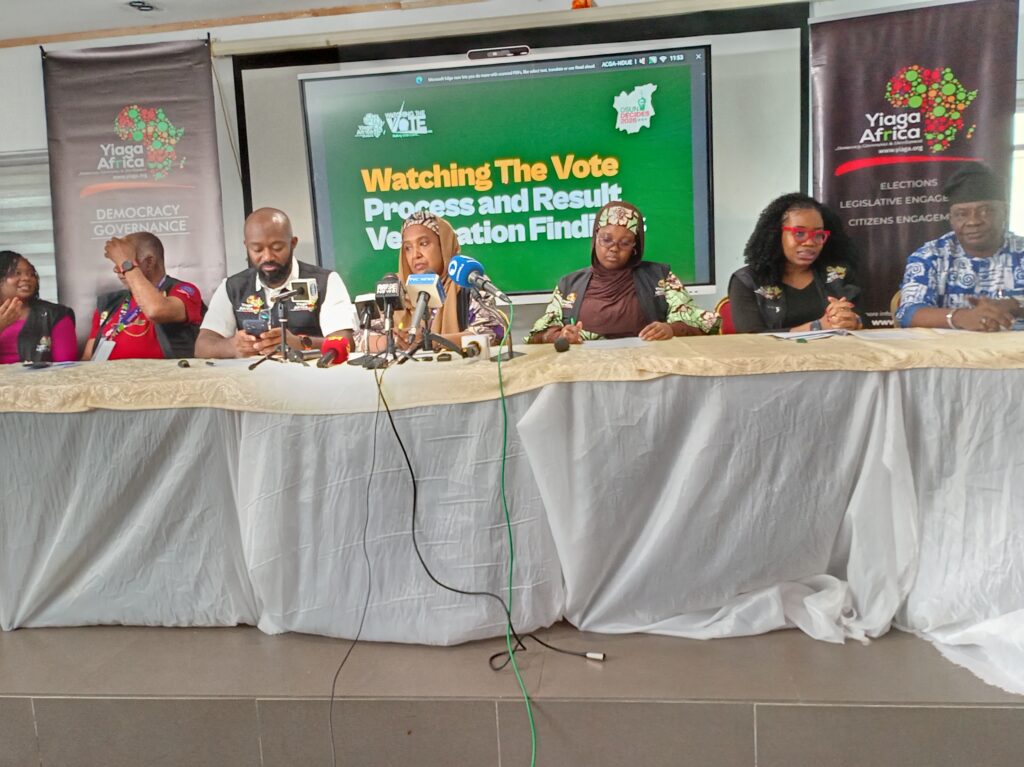
Yiaga Africa said it deployed 300 observers and 32 mobile observers across all 30 Local Government Areas (LGAs), in addition to 30 LGA results collation observers, to independently assess the election-day process and verify the official results announced by INEC.
The statement, titled “Osun 2026: When Technology, Citizens and Institutions Worked for Electoral Integrity,” was based on reports from 289 of the 300 sampled polling units, representing 96 per cent of the organisation’s sample.
According to Yiaga Africa, the Osun election was particularly significant because it was the last major governorship election before the 2027 general election and one of the earliest major tests of the Electoral Act 2026 and the new regulatory framework for election administration and results management.
The organisation said its pre-election assessment had identified the poll as a major test of electoral preparedness, security neutrality and public trust, adding that evidence from election day suggested that INEC and the security agencies largely passed the test.
On election logistics, Yiaga Africa said INEC performed better than expected despite the disruption caused by the last-minute court-ordered inclusion of the Social Democratic Party, which required the commission to reprint ballot papers and result sheets only days before the election.
It said 48 per cent of sampled polling units had commenced accreditation and voting by 8:30 a.m., while the figure rose to 96 per cent by 9:30 a.m.
The organisation said the performance compared favourably with its observations during the 2022 Osun governorship election, when accreditation and voting had commenced in 41 per cent of polling units by 8:30 a.m. and 96 per cent by 9:30 a.m.
On the deployment of electoral technology, Yiaga Africa said the Bimodal Voter Accreditation System (BVAS) was deployed to all polling units, with the device functioning properly in 80 per cent of the sampled locations.
It, however, reported that BVAS malfunctioned in 20 per cent of polling units but was subsequently fixed.
The group said the widespread technological breakdowns feared after problems encountered during the mock accreditation exercise did not occur on a scale capable of undermining the election.
It nevertheless identified some implementation gaps that require attention before the 2027 general election.
In one incident, three unidentified men arrived at Polling Unit 16, Ward 3, Boripe LGA, and began photographing election materials. Their presence agitated voters and led to a confrontation and fight at the polling unit before the men were identified as foreign observers.
At Osogbo LGA, Ward 10, Polling Unit 1, Yiaga Africa said the voter register was initially mixed up with materials meant for another polling unit. Although the matter was resolved after the INEC office was contacted, the incident, together with the placement of an ink pad inside the voting cubicle, delayed accreditation and pushed the commencement of voting beyond 11 a.m.
Yiaga Africa described the resilience of voters as one of the major achievements of the election, noting that citizens turned out to vote despite an atmosphere shaped by the reported attack on Permanent Voter Card collection centres, politically linked violence, disputes over motor parks and weeks of inflammatory political rhetoric.
The organisation estimated voter turnout at between 42.5 per cent and 44.8 per cent, while INEC announced an official turnout of 43 per cent at the State Collation Centre.
Yiaga Africa said the official turnout figure fell within its confidence interval.
The group also commended voters who remained at polling units to witness the sorting, counting and announcement of results and subsequently followed the results to ward and LGA collation centres.
It said such citizen vigilance was an important deterrent to result manipulation, while stressing that citizens should not be required to “stand guard over an institution’s integrity”.
On the INEC Result Viewing Portal (IReV), Yiaga Africa said the platform “reasserted its importance as a game changer” in Nigeria’s election results management.
It said the electronic transmission and publication of polling-unit results strengthened transparency and provided citizens with an additional mechanism to scrutinise the results process.
However, the organisation raised concerns over an interruption in the uploading of results, noting that uploads stalled at 3,292 polling-unit results between 8:48 p.m. and 10 p.m., leaving 471 outstanding results before transmission resumed at approximately 11:50 p.m.
Yiaga Africa called on INEC to provide a clear explanation for the prolonged interruption, saying public confidence in IReV would depend not only on timely and complete uploads but also on proactive communication whenever technological or operational delays occur.
The organisation also assessed the conduct of security agencies, saying their generally professional and restrained approach on election day deserved acknowledgement, particularly against the background of violence and concerns about security neutrality during the campaign period.
It said the election demonstrated that robust security deployment did not necessarily have to result in excessive interference in the electoral process.
However, Yiaga Africa stressed that the standard must be sustained across future elections, saying the true measure of security neutrality would be consistency regardless of the political party controlling the state or federal government.
On the accuracy of the election results, Yiaga Africa’s PRVT estimates closely matched the official INEC results for the major contenders.
According to the organisation, Accord received 51.9 per cent of the official vote, compared with its PRVT estimate of 52.1 per cent, with a margin of error of ±1.9 percentage points.
The ADC recorded 1.7 per cent in the official result and the same 1.7 per cent in Yiaga Africa’s estimate, while the APC’s official result stood at 45.2 per cent against the organisation’s estimate of 44.9 per cent, with a margin of error of ±1.9 percentage points.
Yiaga Africa said the official results for the three major parties fell within its estimated ranges.
It said this indicated that the official results, as announced, reflected the ballots counted at polling units, adding that if the results had been significantly altered at ward, LGA or state collation centres, the official figures would have fallen outside the PRVT estimated ranges.
The organisation, however, warned that the consistency of the results spoke specifically to the accuracy of the tabulation of polling-unit results and did not eliminate concerns about the integrity of voter choice.
It expressed serious concern over widespread reports of vote buying and voter inducement during the election.
Yiaga Africa also documented critical incidents, including an incident at Polling Unit 4, Ada II, Ward 8, Boripe LGA, where voters were reportedly showing party representatives how they had marked their ballot papers.
It also received and verified a report of clashes between supporters of Accord and APC at Polling Unit 5, Ward 11, Boripe LGA. Police officers intervened and safely escorted the INEC official and ballot box from the polling unit.
Looking ahead to the 2027 general election, Yiaga Africa said the Osun experience demonstrated that INEC could meet a high operational standard, implement the Electoral Act 2026 and transmit results transparently when an election was adequately resourced and closely monitored.
It warned, however, that the challenge would be to reproduce the same standard across 176,000 polling units and 36 states during the 2027 elections.
The organisation urged INEC to convert the lessons from Osun into institutional standards by strengthening quality assurance for sensitive election materials, resolving inconsistencies in voter data, standardising the implementation of downloadable Permanent Voter Cards and other provisions of the Electoral Act 2026, improving the resilience and transparency of IReV, and institutionalising prompt public communication whenever technological or operational failures occur.
Yiaga Africa also called on security agencies to strengthen enforcement against vote buying, intimidation and electoral violence while maintaining neutrality.
Among its specific recommendations, the organisation urged INEC to issue binding and uniform guidance to presiding officers on the acceptance and use of downloadable PVCs for voter accreditation.
It also called for a comprehensive post-election technical audit of BVAS devices to establish the causes of failures and improve device testing, maintenance and rapid technical support ahead of 2027.
The commission was further urged to publish the causes of biometric authentication failures recorded during accreditation and outline remedial measures.
Yiaga Africa recommended more effective training of ad hoc election officials, stronger oversight of field personnel and consistent application of election-day procedures.
On security, it urged the authorities to review their deployment strategy ahead of 2027 and ensure the joint movement of security officials, polling officials and election materials from Registration Area Centres to polling units on election day.
It also called on the Nigeria Police Force to publish a report on its deployment during the Osun election, including the number of arrests made and plans for prosecution.
According to Yiaga Africa, such transparency would help ensure that perpetrators of pre-election violence that resulted in the death of citizens are properly prosecuted.
The organisation further urged political parties to strengthen their commitment to democratic values by systematically training polling agents on the Electoral Act 2026, INEC regulations and guidelines, as well as voter education ahead of 2027.
It also called on security agencies, the Economic and Financial Crimes Commission (EFCC) and the Independent Corrupt Practices and Other Related Offences Commission (ICPC) to extend enforcement beyond polling-unit premises to surrounding areas where voter inducement may occur, and to arrest and prosecute offenders, including party financiers and agents.
Yiaga Africa commended the people of Osun State for their resilience and commitment to the democratic process, urging them to remain engaged after the election by holding political parties and elected officials accountable for their campaign promises.
The organisation said it would release a comprehensive report containing additional data and recommendations as it begins its national deployment for the 2027 general elections.
Yiaga Africa deployed its Watching the Vote election observation methodology for the Osun election as part of a broader civil society observation effort supported by the European Union under the European Union Support to Democratic Governance in Nigeria (EU-SDGN).
The organisation commended its 332 observers who monitored the electoral process at polling units, LGA collation centres and the state collation centre across Osun State.
It reaffirmed its Watching the Vote commitment of being “Driven by Data For All Nigerians, Beholden to None” and said the lessons from Osun should inform efforts to strengthen Nigeria’s electoral system ahead of 2027.







No Comment! Be the first one.